
Assault is one of the most commonly filed charges in San Diego criminal courts, and one of the most misunderstood. Under California law, assault does not require that anyone was actually hit or hurt — an attempt to use force, combined with the present ability to do it, is enough. A swing that misses or a shove that never lands can be charged as assault.
Assault allegations arise out of everyday situations: an argument outside a bar, a road-rage confrontation, a dispute between neighbors. The person who calls 911 first often shapes the police report, and charges can be filed on a one-sided account long before anyone hears your side.
A conviction can carry jail or prison time, fines, probation, and lasting consequences for employment, licensing, and immigration status. At the Law Office of Marc S. Kohnen, we focus on getting in front of the case early — preserving evidence, challenging the prosecution's version of events, and working toward reduction or dismissal wherever the facts allow.
What Is the Difference Between Assault and Battery?
Assault and battery are often spoken about as one crime, but under California law they are separate offenses that are frequently charged together.
California Penal Code section 240 defines assault as an unlawful attempt, coupled with a present ability, to commit a violent injury on another person. The key word is attempt. No touching is required. If you willfully did something that would probably result in force being applied to someone, and you had the ability to follow through, that can be assault — even if no contact was made and no one was injured.
California Penal Code section 242 defines battery as any willful and unlawful use of force or violence upon another person — the completed act, actual physical contact. It does not have to cause injury; an offensive or unwanted touching, like a shove or a grab, can qualify.
One way to think about it: every battery generally includes an assault, but an assault can occur without any battery at all. The distinction matters for your defense — an assault case often turns on intent and ability, while a battery case turns on whether the contact was willful and whether you were defending yourself.
If the alleged victim is a spouse, partner, or someone in your household, the same conduct may instead be charged under California's domestic violence statutes, which carry their own consequences and mandatory conditions.
How Assault Charges Escalate Under California Law
Not all assault charges are created equal. California law builds an escalation ladder, and where your case lands on it drives the potential sentence, the misdemeanor-or-felony question, and the collateral consequences.
At the bottom are simple assault under Penal Code 240 and simple battery under Penal Code 242 — misdemeanors, typically punishable by county jail time measured in months, fines, and probation.
Battery causing serious bodily injury, under Penal Code 243(d), is where things change. If the alleged victim suffered a serious impairment of physical condition — the statute's examples include bone fractures, concussions, loss of consciousness, and wounds requiring extensive suturing — the charge becomes a wobbler: prosecutors can file it as either a misdemeanor or a felony.
Assault with a deadly weapon, under Penal Code 245(a)(1), covers assaults committed with a weapon or instrument other than a firearm. Penal Code 245(a)(4) covers assault by means of force likely to produce great bodily injury — no weapon required. Both are wobblers, and felony filings carry potential state prison exposure.
California also singles out certain victims for extra protection. Assault on a peace officer, firefighter, EMT, and other protected persons is charged under Penal Code 241, and battery on those categories under Penal Code 243(b) and 243(c). When the person was performing their duties and the defendant knew or reasonably should have known it, penalties increase — and an injured officer can mean a felony filing. Assaults on peace officers or firefighters involving a deadly weapon or a firearm are charged separately under Penal Code 245(c) and (d), which carry longer prison terms.
Where a case lands on this ladder is not fixed. Part of the defense job is showing prosecutors — or a judge or jury — why a charge belongs lower on the ladder, or off it entirely.
Great Bodily Injury Enhancements and Strike Consequences
Beyond the underlying charge, prosecutors can attach sentencing enhancements that dramatically change what a conviction means.
The most significant in assault cases is the great bodily injury enhancement under Penal Code 12022.7. A finding that you personally inflicted great bodily injury during a felony adds an additional and consecutive prison term — three years in the typical case, and more where the alleged victim was elderly, a young child, or left comatose or paralyzed — on top of the sentence for the underlying offense.
The long-term consequences matter just as much. A felony conviction that includes a great bodily injury finding, or a finding that you personally used a deadly weapon, can generally qualify as a serious or violent felony under California law — commonly called a strike — affecting sentencing in any future felony case and limiting credits and release options. The precise consequences depend on the specific charge, findings, and your history.
In practice, the fight in a felony assault case is often as much about the enhancement allegations as about guilt: whether the injury truly rises to great bodily injury, whether you personally inflicted it, and whether the object involved was actually a deadly weapon. Winning those fights can be the difference between a strike felony and a resolution you can move on from.
What Counts as a Deadly Weapon in California?
People hear assault with a deadly weapon and picture a knife or a gun. California law defines the term far more broadly: generally, any object or instrument used in a way that is capable of producing, and likely to produce, death or great bodily injury.
The definition is case-by-case and turns on how the object was used, not what it is. Courts have treated cars driven at people, bottles, bats, tools, and ordinary household objects as deadly weapons when wielded dangerously. A beer bottle on a table is just a bottle; swung at someone's head, prosecutors will call it a deadly weapon.
The flip side is that the label can be challenged. Whether an object was actually used in a manner likely to cause serious harm depends on distance, force, angle, and intent — details police reports frequently gloss over and that video, physical evidence, and cross-examination can pull apart.
Wobblers, Felony Filing Decisions, and Penal Code 17(b)
Several of the most common assault-related charges — including battery with serious bodily injury and aggravated assault under Penal Code 245(a) — are wobblers: the district attorney chooses whether to file the case as a misdemeanor or a felony, and a judge retains power over that classification later.
Prosecutors typically weigh how badly the alleged victim was hurt, whether a weapon was involved, the defendant's record, and the overall circumstances. A first-time accusation arising from a mutual scuffle looks very different to a filing deputy than an unprovoked attack with visible injuries. Effective defense work often starts before the filing decision, pushing the case toward a misdemeanor — or no filing at all.
Even after a felony is filed, the door is not closed. Under Penal Code 17(b), a judge can reduce a wobbler felony to a misdemeanor at several points in the case, including at a preliminary hearing, at sentencing, or in some situations after probation is completed. It is a tool we evaluate in every wobbler case, because the difference between a felony and a misdemeanor on your record is enormous.
Self-Defense and Defense of Others in Fight Cases
Many assault cases are, at bottom, fight cases — and fights rarely have a clean narrative. California law entitles you to defend yourself, or someone else, if you reasonably believed you were in imminent danger and used no more force than reasonably necessary.
Self-defense cases turn on recurring questions. Who started it? What did each person say and do in the seconds before contact? Was the force you used proportional to the threat? Even someone who initially agreed to a mutual fight can regain the right to self-defense in certain circumstances, such as clearly trying to stop fighting or facing a sudden escalation. These are fact-intensive rules that depend on the details of your incident.
Proving those details is where cases are won and lost. Surveillance footage from bars, parking lots, and doorbell cameras is routinely overwritten within days or weeks. Witnesses scatter or were never interviewed by police at all. Defensive wounds and marks showing you were attacked first need to be photographed before they heal. The earlier a defense investigation starts, the more of this evidence survives.
How Assault Charges Really Get Filed — and Why Early Defense Work Matters
In many San Diego assault prosecutions, police arrive after everything is over, talk to whoever is still there or called first, and write a report built largely on one side's account. The prosecutor deciding what to charge usually reads that report and little else.
This is especially true in bar fights, party altercations, and disputes between people who know each other. The person with visible injuries, or the more sympathetic story, tends to become the victim in the paperwork — even when they threw the first punch.
That is why the weeks immediately after an arrest matter so much. In that window, a defense team can send preservation letters before surveillance footage is erased, interview witnesses while memories are fresh, photograph injuries and the scene, and in appropriate cases present evidence to the prosecutor before charges are filed. At the Law Office of Marc S. Kohnen, that early investigation is standard practice.
Resolutions Short of Trial: Civil Compromise, Diversion, and Anger Management
Not every assault case should go to trial — or end in a conviction. Depending on the charge, your record, and the alleged victim's position, there may be resolutions that leave your record clean or nearly so.
California law allows civil compromise in certain misdemeanor cases under Penal Code sections 1377 and 1378: the alleged victim acknowledges in court that they have been compensated for their losses, and the judge, in their discretion, may dismiss the case. It is not available in every case — the statute excludes categories such as domestic violence, offenses against officers acting in their official capacity, and elder abuse — but where it fits, it can end a case outright and bars re-prosecution.
San Diego courts also have discretion to grant misdemeanor diversion in many cases, allowing a defendant to complete conditions such as anger management classes, community service, or counseling in exchange for dismissal. Eligibility depends on the offense and the judge's assessment, and some charges are excluded. Where diversion is realistic, it can be the cleanest available outcome: no conviction, and a dismissed case.
Even when formal diversion or compromise is not available, voluntarily completing anger management or counseling can influence how a prosecutor negotiates and how a judge sentences. Part of our job is identifying which of these options genuinely applies to your situation — while keeping trial fully prepared if the offer is not good enough.
A San Diego Assault Lawyer Who Has Won at Trial
Plea bargains are negotiated in the shadow of trial. Prosecutors extend better offers when they know a defense lawyer is prepared to pick a jury.
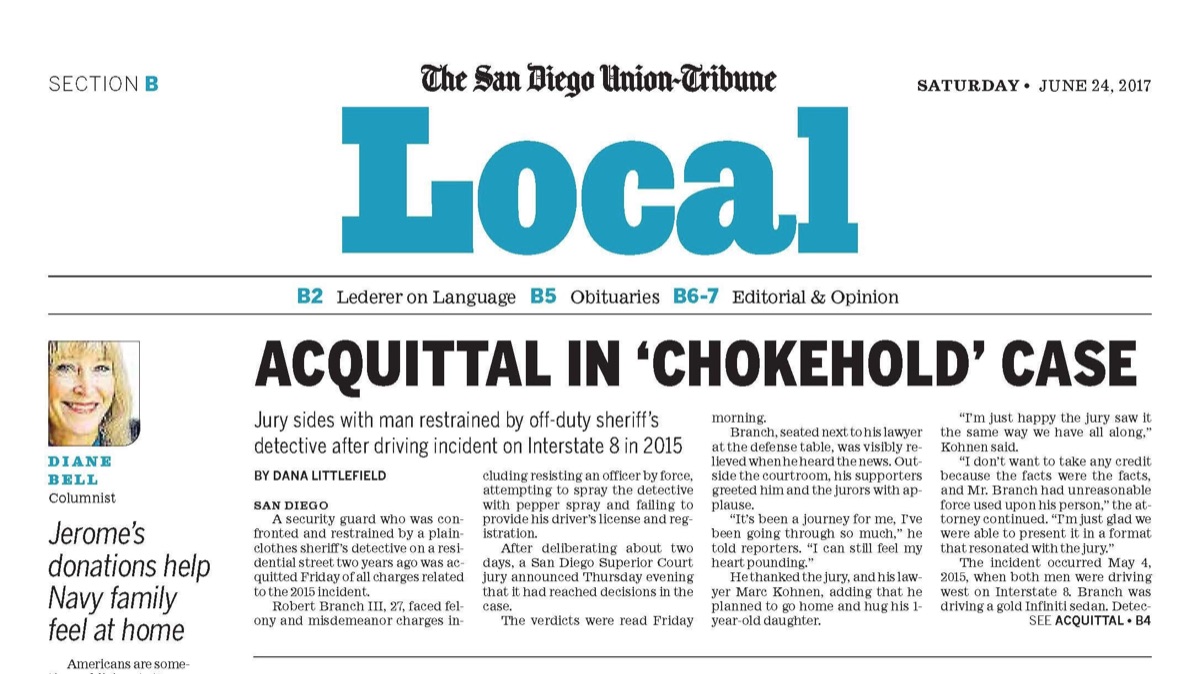
Marc Kohnen has taken assault allegations through jury trial and won. In one widely covered San Diego case, his client was found NOT GUILTY of assault charges — a verdict that made the front page of the San Diego Union-Tribune. No past result predicts any future outcome, but it does mean your case is handled by an attorney who prepares every matter as if a jury will decide it.
From the first meeting, Marc handles the case personally — reviewing the evidence with you, explaining the real risks and opportunities, and giving you straight answers rather than empty reassurance.
Frequently Asked Questions About Assault Charges in San Diego
Answers to the questions clients most often ask in a first meeting.
Can I be charged with assault if I never touched anyone?
Yes. Under Penal Code 240, assault is an attempt to use force with the present ability to do it — no contact is required. A punch that misses or an object thrown that never connects can support an assault charge. Prosecutors must still prove your act was willful and would probably have resulted in force being applied; words alone or ambiguous movements often fall short, and that gap is frequently where the defense lives.
Is my assault charge a misdemeanor or a felony?
It depends on the statute and the prosecutor's charging decision. Simple assault and simple battery are misdemeanors. Battery with serious bodily injury and aggravated assault under Penal Code 245(a) are wobblers, and the filing decision is driven mainly by the injuries, any weapon, and your record. If your case was filed as a felony wobbler, reduction under Penal Code 17(b) may be possible at several stages — it is one of the first things we assess.
The other person started the fight. Does that matter?
It can matter a great deal. California recognizes self-defense and defense of others when you reasonably believed you faced imminent harm and responded with proportional force. Who initiated the confrontation and how the force escalated are central questions. But these defenses rise or fall on evidence — video, witnesses, injury photographs — much of which disappears quickly. If you acted in self-defense, get a defense investigation started immediately and say nothing to police until you have counsel.
Can the case be dismissed if the other person doesn't want to press charges?
Not automatically. The decision to prosecute belongs to the district attorney, not the alleged victim, and prosecutors regularly proceed even when the other person wants the case dropped. That said, a reluctant complaining witness weakens the case in practice, and civil compromise or misdemeanor diversion may offer a formal path to dismissal in eligible cases.
Book an Initial Consultation with a San Diego Assault Attorney
If you have been arrested, cited, or contacted by police about an assault or battery allegation in San Diego County, the next few days matter. Do not give a statement, do not discuss the incident with anyone — including the other person involved — and get counsel involved while the evidence still exists.
At the Law Office of Marc S. Kohnen, we start with a candid assessment: what you are actually facing, where the prosecution's case is weak, and which outcomes are realistically achievable. Then we build a defense tailored to your facts — pushing for no filing, negotiating a reduction or diversion, or preparing for trial. Contact the office today to schedule an initial consultation with a San Diego assault lawyer who will handle your case personally from start to finish.
Legally reviewed by Marc S. Kohnen, Attorney at Law, State Bar of California #255303, defending San Diego since 2008.
Free, confidential case evaluation, available 24 hours at (619) 398-2500.